Timeboxing Journal KDP Interior V-03: A Practical Evaluation for Self-Publishers and Planners
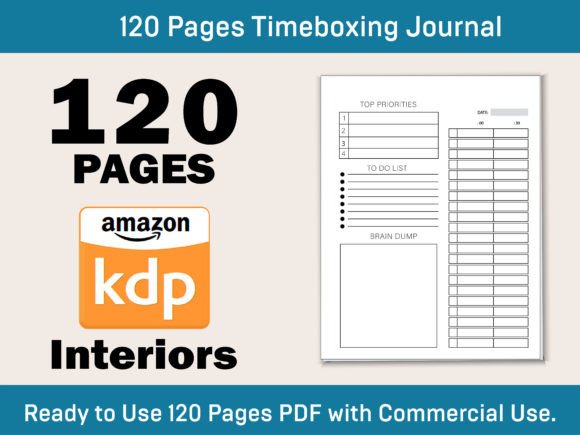
The Timeboxing Journal KDP Interior V-03 is a 120-page digital printable designed specifically for Amazon KDP self-publishing. It’s not a physical notebook or a subscription-based app—it’s a ready-to-upload PDF interior file, optimized for the KDP platform and tested for compatibility. At its core, it offers a structured daily layout built around timeboxing: a productivity method where fixed blocks of time are assigned to specific tasks. This version uses 30-minute increments, beginning at 5:00 AM and ending at 11:30 PM—covering a full 18.5-hour span across 37 slots per day.
What Sets This Interior Apart from Generic Planners
Unlike broad-format undated planners or minimalist bullet journals, the Timeboxing Journal KDP Interior V-03 commits to a consistent, time-driven structure. Each of the 120 pages includes:
- A clearly labeled date and day of the week
- Space for up to three top priorities
- A dedicated “brain dump” section for capturing scattered thoughts or ideas
- A “for tomorrow” prompt to support forward-looking reflection
- A grid of 37 time slots (5:00–11:30), each marked in 30-minute intervals
This level of granularity supports users who benefit from visual time mapping—especially those managing overlapping responsibilities like remote work, caregiving, creative projects, or study schedules. The absence of bleed and the 8.5″ × 11″ dimensions mean it prints cleanly on standard US letter paper without cropping risk, and the 300 DPI resolution ensures crisp text and lines when printed or viewed digitally.
How It Fits Into the Broader Landscape of Productivity Tools
When evaluating tools for time management, people often compare digital apps (like Clockify, Toggl Plan, or Notion templates), physical notebooks (such as Leuchtturm1917 or Passion Planner), and other KDP interiors. The Timeboxing Journal KDP Interior V-03 occupies a distinct middle ground: it’s more structured than blank journal pages but less dynamic than software with reminders, syncing, or analytics.
Compared to digital timers or calendar-based time blocking, this journal requires manual entry—but that very friction can reinforce intentionality. Research suggests that handwriting tasks increases retention and commitment compared to typing alone. For users who find notifications overwhelming or who prefer tactile feedback, the physical act of filling in time blocks may support deeper focus.
Against other KDP planner interiors, the Timeboxing Journal KDP Interior V-03 stands out for its narrow focus. Many competing interiors blend habit tracking, mood logging, gratitude prompts, and weekly reviews—all valuable, but potentially diluting the timeboxing function. Here, every element serves one purpose: helping the user allocate attention deliberately across the day.
Strengths and Realistic Tradeoffs
Strengths:
- Platform-ready simplicity: No formatting adjustments needed—just upload the single PDF to KDP and publish. That saves hours for creators unfamiliar with print-on-demand technical requirements.
- Predictable structure: With uniform spacing and consistent headers, readers know exactly what to expect on each page. That predictability reduces decision fatigue during daily use.
- Flexibility within constraint: While time slots are fixed, users decide what goes into them. A student might block 6:00–7:30 for reading, while a freelancer could assign that window to client calls or deep work.
Tradeoffs:
- No customization in the file itself: You can’t rearrange sections, add new pages, or adjust font size without editing the PDF—a step requiring design software and KDP re-testing.
- Limited adaptability for non-traditional schedules: If your most productive hours fall outside the 5:00 AM–11:30 PM range—or if you need 15- or 45-minute blocks—the layout won’t shift to accommodate it.
- No built-in review system: Unlike some planners with monthly summaries or progress trackers, this version focuses solely on daily execution. Users seeking long-term pattern analysis would need to supplement externally.
Who Benefits Most—and When Another Option May Fit Better
The Timeboxing Journal KDP Interior V-03 suits creators and end users who value consistency over novelty. It works well for:
- Self-publishers launching their first KDP planner and wanting a low-risk, high-clarity interior to test market response
- Remote workers or freelancers who juggle multiple clients and need to visualize capacity before overcommitting
- Students preparing for exams or thesis writing, especially those who respond well to visible time boundaries
- Neurodivergent individuals who benefit from external scaffolding for task initiation and transitions
Conversely, it may be less suitable for:
- People who prefer digital-first workflows and want cloud sync, search, or automated reporting
- Teams or managers needing shared calendars or collaborative editing features
- Those whose routines vary drastically day-to-day (e.g., shift workers with rotating start times)
- Users seeking aesthetic variety—this interior prioritizes function and clarity over decorative elements or seasonal themes
Practical Use Cases: Beyond the Obvious
While timeboxing is often associated with productivity hacking, real-world application reveals subtler benefits. One teacher used the Timeboxing Journal KDP Interior V-03 to plan lesson prep, grading, and parent communication across a 12-hour school day—not to maximize output, but to protect time for rest and reflection. Another small-business owner paired it with a simple spreadsheet to track how much time actually went to marketing vs. operations, revealing misalignments they hadn’t noticed in calendar apps.
In both cases, the journal served less as a strict schedule and more as a diagnostic tool: a neutral record of intention versus reality. That kind of insight doesn’t require AI or complex dashboards—just honest, repeated engagement with the same format.
Making an Informed Choice
Choosing the right planner interior—or recommending one to others—depends less on features and more on alignment with actual behavior. The Timeboxing Journal KDP Interior V-03 doesn’t promise transformation. It offers structure, clarity, and compatibility—three quiet advantages in a crowded space of productivity tools.
If your goal is to publish quickly on KDP with minimal technical overhead, and your audience values predictability and focused time management, this interior delivers reliably. If instead you’re building a brand around personalization, community features, or adaptive learning, you’ll likely need to layer additional resources—or choose a different foundation entirely.
As with any tool, its effectiveness grows not from how many pages it contains, but how consistently and thoughtfully it’s used. The Timeboxing Journal KDP Interior V-03 gives users 120 opportunities to practice that consistency—one 30-minute block at a time.