Baby Memory Book Canva KDP Interior
There’s a quiet magic in the first year of a baby’s life—tiny fingers gripping yours, sleepy smiles at 3 a.m., that first wobbly grin captured mid-yawn. These aren’t just moments; they’re emotional anchors. And yet, without structure, they slip away: forgotten in photo dumps, buried in text threads, or lost in the exhaustion of early parenthood. That’s where the Baby Memory Book Canva KDP Interior steps in—not as another checklist, but as a thoughtful, flexible vessel for meaning.
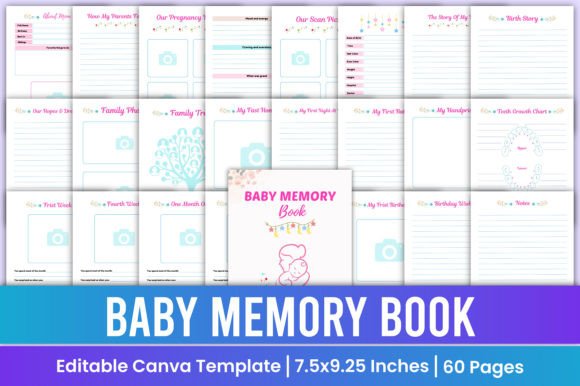
This isn’t a static PDF you print and fill with a pen. It’s a fully editable, print-ready interior designed for Canva—7.5 × 9.25 inches, optimized for professional KDP publishing and personal use alike. Every page is built with intention: clean layouts, balanced white space, and intuitive sections that guide new parents (or soon-to-be parents) through storytelling—not just data entry. You don’t need design skills. You do need warmth, presence, and the desire to hold time gently.
What Makes This Interior Stand Out
First, it’s *designed for real life*. Not idealized life. The “How My Parents Found Out” spread includes space for screenshots, ultrasound snippets, or even a handwritten note beside a coffee stain. “Mood and Energy” isn’t a clinical log—it’s a soft, illustrated prompt inviting honesty about pregnancy fatigue, joy, doubt, or awe. Even the “First Week to Four Weeks” section avoids rigid day-by-day pressure, offering gentle prompts like “One thing I learned about myself this week” alongside milestones.
The technical execution supports that humanity. Each template is layered in Canva with locked backgrounds and editable text boxes—no accidental resizing or font overrides. Colors, fonts, and layout styles shift seamlessly across pages. Want coral accents instead of sage? Swap it globally in one click. Prefer a serif headline font for gravitas and a rounded sans for captions? Done. And because it’s built for KDP, bleed, margins, and CMYK-safe color palettes are pre-configured—no last-minute panic over trim lines.
More Than Just a Keepsake—A Practical Tool Across Contexts
For creators and entrepreneurs selling on Amazon KDP, this interior solves a common bottleneck: high-quality, emotionally resonant interiors that convert. Buyers scroll past generic templates. They pause at ones that feel *lived-in*. This Baby Memory Book Canva KDP Interior delivers that authenticity—while staying commercially viable. You can brand it subtly (a custom logo on the “Belongs To” page), add your own intro note, or bundle it with matching journal covers or milestone cards.
Educators and doulas use it in prenatal workshops—not as a product pitch, but as a tactile conversation starter. When expectant parents edit the “Our Hopes and Dreams” spread live in class, something shifts. It moves hope from abstract to actionable. Freelance photographers include it as a premium add-on: clients receive not just edited images, but a curated framework to tell their story *around* those images—deepening perceived value and retention.
Even hobbyists benefit. One freelance illustrator told us she used the “Family Tree” and “My First Home” spreads as sketchbook prompts—redrawing the layouts by hand, then scanning them back in. Another small-batch stationery seller adapted the “Teeth Growth Chart” into a printable growth tracker for her Etsy shop, crediting the original structure as her springboard.
Real-World Usability Wins
Usability here isn’t about speed—it’s about reducing friction during emotionally complex times. Consider the “Birth History” page: instead of asking for medical details upfront, it opens with “The moment I knew you were coming,” then flows into timing, location, and people present. That order matters. It meets parents where they are—not in clinical recall, but in visceral memory.
Print readiness is non-negotiable. The included PDFs are press-ready: embedded fonts, flattened layers, correct resolution (300 DPI), and crop marks. No re-exporting nightmares. If you’re uploading to KDP, you drop the file in—and go. For personal printing, the 7.5 × 9.25 size fits standard photo book bindings and local print shops without cropping surprises.
Smart Implementation Tips
Before editing, skim all pages once—not to fill them, but to notice rhythm. Some spreads (like “Smile” or “My First Birthday”) thrive with minimal text and strong visuals. Others (“The Story of My Name,” “Memories From My First Year”) invite longer reflection. Let the content dictate density—not the other way around.
If you’re building a KDP listing, pair this interior with a cover that echoes its tone: warm, uncluttered, and softly textured—not stock-photo perfect, but tenderly real. Avoid overloading the description with every section name. Instead, highlight *how it helps*: “Designed so you can record milestones without pressure—because some days, just getting dressed counts as a win.”
And if you’re a parent using it personally? Give yourself permission to skip pages. Fill in “Hello I’m Here” three weeks postpartum—even if “here” means curled up on the couch, nursing at dawn. The power isn’t in completion. It’s in showing up, again and again, with kindness.
Why This Fits Where Others Fall Short
Many baby journals lean either too clinical (checklists, rigid timelines) or too decorative (so much art, no room for words). This Baby Memory Book Canva KDP Interior lives in the middle—structured enough to provide scaffolding, open enough to breathe. It assumes parents are capable, tired, creative, inconsistent, loving, and human.
It also respects the full spectrum of family structures. The “About Mom” page works equally well for “About Us,” “About My Parents,” or “About My Chosen Family.” The “Family Photo” and “Family Tree” spreads include adaptable labels—not assumptions. That flexibility isn’t an afterthought. It’s baked into the layer naming and copywriting.
In a market flooded with “cute” templates, this interior earns trust—not through polish alone, but through empathy engineered into every pixel and paragraph. It doesn’t ask you to be perfect. It asks you to begin.