Mindful Eating Log Book KDP Interior
Launching a low-content publishing business on Amazon KDP demands precision—not just in concept, but in execution. The Mindful Eating Log Book KDP Interior stands out because it bridges intention and practicality: it’s not merely a printable journal—it’s a production-ready, field-tested interior file designed to minimize friction and maximize reliability when uploading to Kindle Direct Publishing.
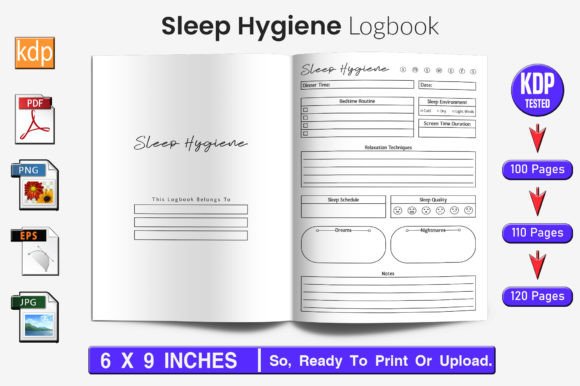
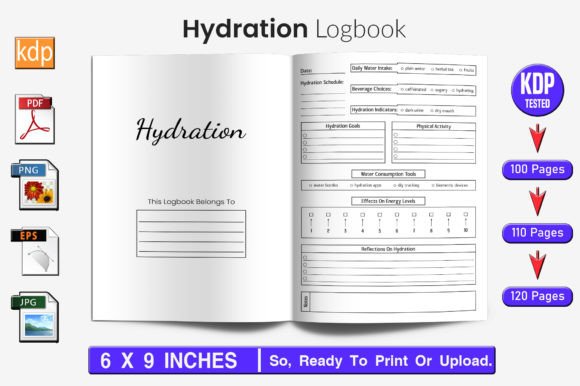
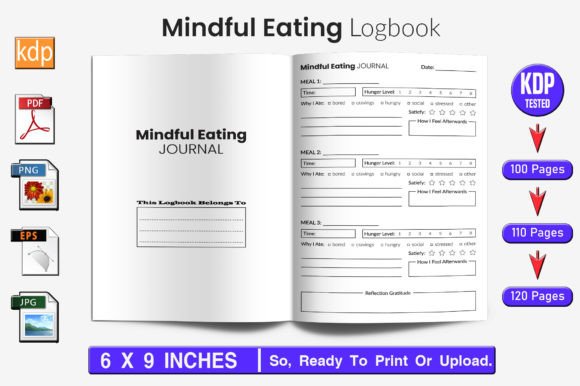
This isn’t a generic template repackaged for resale. It’s a 100-page (with optional 110- and 120-page versions) interior built specifically for mindful eating tracking—clean, uncluttered, and grounded in behavioral awareness principles. Each page supports reflection without distraction: space for noting hunger cues, food choices, emotional context, pace of eating, and post-meal sensations. That structure matters. Users don’t just log meals—they build self-awareness over time, and publishers benefit from repeatable, meaningful utility.
Why “KDP Tested” Is More Than a Badge
“KDP tested” means the file has passed real-world validation—not just theoretical compliance. It includes no bleed (critical for avoiding unintended white borders or cutoff text), renders correctly at 300 DPI, and uses a standard 6×9 trim size—the most widely adopted for journals and wellness logs. That translates directly into fewer upload rejections, faster approval cycles, and reduced revision loops. For creators managing multiple titles, that consistency saves hours per title—time better spent refining covers, optimizing keywords, or engaging with readers.
Unlike raster-based PDFs that pixelate when resized, this interior is delivered as a vector-based package: editable EPS source files, scalable PDFs, transparent-background PNGs, and high-res JPGs. If you need to adjust margins for a custom spine width, shift line spacing for accessibility, or adapt the layout for a bilingual version, you can do so without quality loss. Adobe Illustrator users gain full layer control; others can use the ready-to-upload PDF immediately.
A Tool Built for Real Publishing Workflows
Professionals launching their first KDP journal—or scaling a catalog of 50+ low-content titles—need interiors that integrate smoothly into existing systems. The Mindful Eating Log Book KDP Interior supports that. Its modular design allows quick customization: swap headers, update fonts for brand alignment, insert subtle watermarks, or add short instructional footers (“Pause before your first bite”) without disrupting layout integrity. Because it’s vector-based, resizing from 6×9 to 5×8 or even 7×10 remains crisp—ideal if you’re testing variants across niches like stress-eating support, postpartum nutrition, or diabetes-aware meal tracking.
Educators and health coaches sometimes adapt such logs for client handouts. With the included transparent PNGs, they can overlay pages onto slides or embed them into digital workbooks. Freelance designers use the EPS files to create companion products—like matching cover templates or social media quote graphics—without rebuilding from scratch.
Who Benefits Most—and Why Timing Matters
This interior serves three overlapping audiences especially well:
- First-time KDP publishers who want to launch confidently: the file eliminates guesswork around formatting, bleed, and resolution—common pain points that delay launches or trigger rejection emails.
- Established low-content sellers iterating quickly: having a vetted, editable base cuts interior creation time from days to under an hour per new variation (e.g., seasonal themes, gender-neutral palettes, or age-targeted prompts).
- Wellness professionals building branded resources: dietitians, therapists, and yoga instructors can personalize the log with their logo, intake questions, or evidence-informed reflection prompts—then sell it directly or via KDP as a value-add to their practice.
That said, it’s not a universal fit. If your goal is highly illustrated content—think hand-drawn icons on every page, embedded infographics, or multi-column nutritional comparison tables—this interior prioritizes clean typography and functional whitespace over dense visual storytelling. Similarly, if you require CMYK color profiles for offset printing (beyond KDP’s standard process), you’ll need to convert the RGB assets accordingly—a straightforward step, but one worth noting upfront.
Thoughtful Customization Without Compromise
One underrated strength lies in how the interior balances flexibility with restraint. The editable files let you modify font families, change line heights, or reposition date fields—but the underlying grid system remains stable. That prevents accidental misalignment when adjusting elements across 100+ pages. You won’t face cascading layout breaks mid-document, a frequent issue with poorly structured templates.
For example, a freelance writer developing a mindfulness course might add a weekly summary page every 7th entry—using the provided EPS layers to duplicate and edit seamlessly. A small business owner launching a subscription box could insert a QR code linking to video guidance, placed precisely in the footer using the transparent PNG guide. These aren’t hypotheticals; they’re documented adaptations from actual users who reported going from file download to live KDP listing in under 45 minutes.
Practical Next Steps for Publishers
If you’re evaluating this interior against alternatives, ask two questions: First, does the file include *both* production-ready PDFs *and* fully editable source assets? Many listings offer only flattened PDFs—limiting future revisions. Second, has it been validated on KDP *within the last six months*? Platform requirements evolve; older files may miss recent updates to margin tolerances or metadata handling.
The Mindful Eating Log Book KDP Interior meets both criteria. Its inclusion of bonus JPGs also streamlines thumbnail creation for Amazon previews—no extra cropping or compression needed. And because it’s built around a proven behavioral framework (not just aesthetics), it supports long-term reader retention: people return to journals that feel useful, not decorative.
Ultimately, success in low-content publishing hinges less on volume and more on velocity + validity. This interior accelerates the former while anchoring the latter in real usability, KDP compliance, and thoughtful design discipline. Whether you're launching your third journal or your thirtieth, reducing technical overhead means more bandwidth for what truly differentiates your work: voice, vision, and value.